Under review · 2026

PhyEvolve: Multi-Agent State-Evolution Planning for Physics-Aware Video Generation

Yang-Hao Zhou† Lixing Tan† Zhiqi Li Guang Yang Xiao Yang∗,‡
Canva Research
†Equal contribution  ·  ∗Corresponding author  ·  ‡Project leader

We formulate prompt enhancement for physics-aware video generation as semantic completion through structured state-evolution planning. In PhyEvolve, a Director disentangles physical events from observation changes, a Physical Evolver constructs causally linked state transitions that unfold whether visible or not, and a Composer expresses them in a replacement prompt. Without retraining or modifying the generator, PhyEvolve outperforms the strongest prior agentic baseline by 7.9 points on average across four benchmarks.

1

Overview video

2

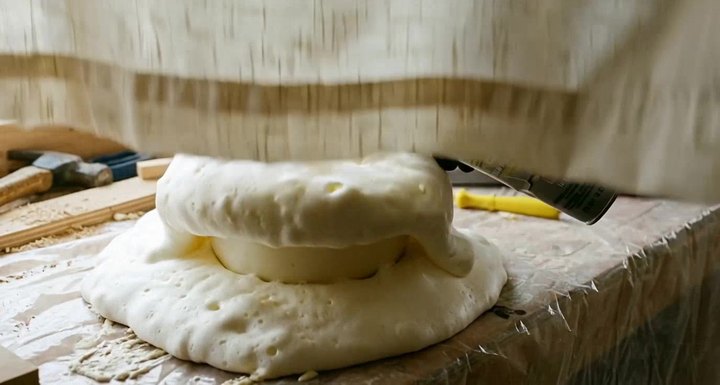
What happens out of sight?

The curtain only changes what the camera sees. The foam keeps expanding while hidden, so when the curtain rises the scene must reveal the state it has reached — not restart.


1.5 s, bowl filling 3.3 s, curtain drops 5 s, out of sight 7.2 s, curtain rises 7.9 s, foam overflowed
1.5 s · Bowl filling3.3 s · Curtain drops5 s · Out of sight7.2 s · Curtain rises7.9 s · Foam overflowed
VisibleHidden (curtain)Visible
Evolving state: dispensing and expansion continue while hidden
Input prompt P: “While the hand keeps pressing the trigger, a heavy curtain drops from the ceiling between the camera and the bowl, completely blocking the bowl and spray can from view, without touching or interacting with any object in the scene … After a pause, the curtain rises.”
Minimax-H3
PhyEvolve
✓ Foam overflows while hidden
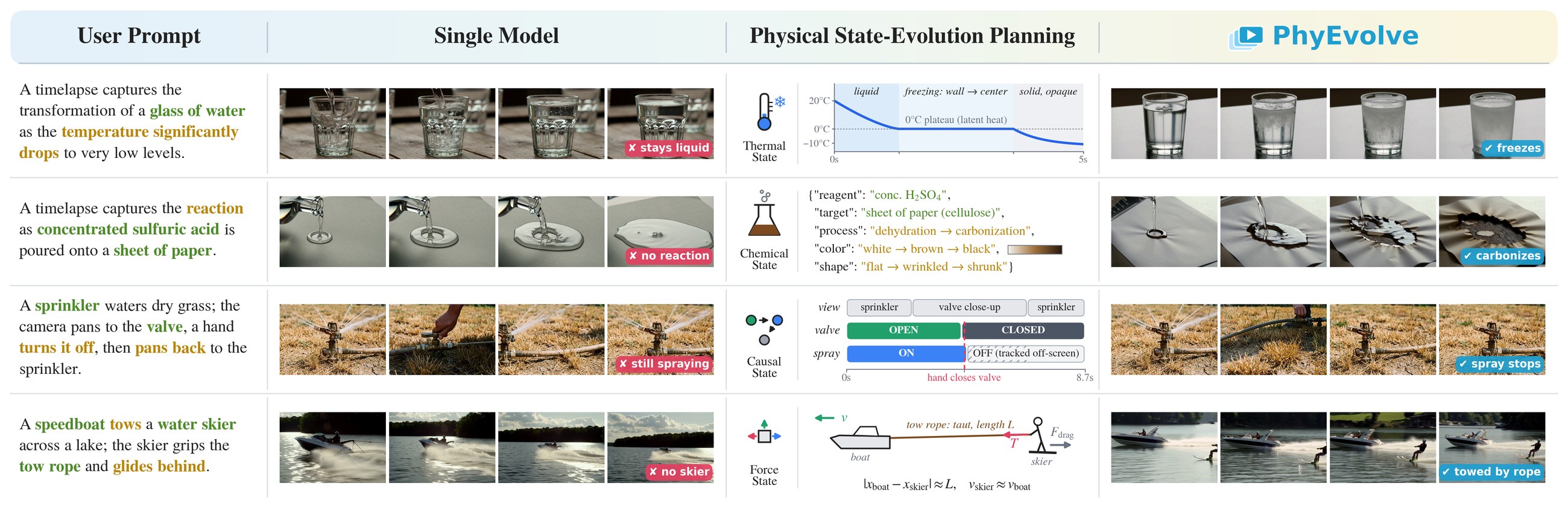
Teaser: single model vs PhyEvolve on thermal, chemical, causal and force states
A single model renders a moment; PhyEvolve plans an evolution. For each request, PhyEvolve infers the physical state that must change (thermal, chemical, causal or force) and writes it into the prompt, so the same frozen generator produces the progression the text implies.
3

Method

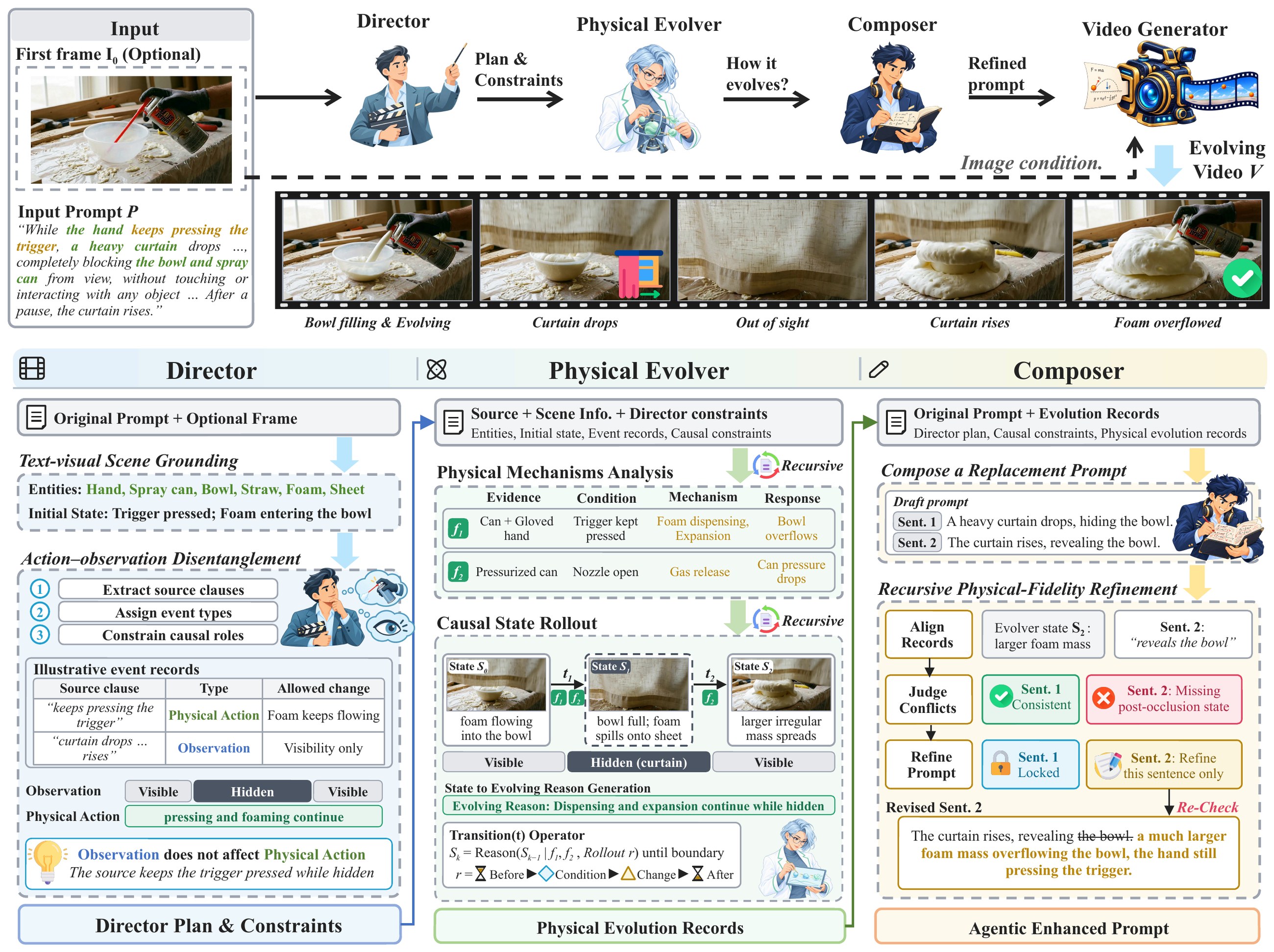
Overview of PhyEvolve: Director, Physical Evolver and Composer turn the input prompt and optional first frame into a refined prompt for a frozen video generator
Overview of PhyEvolve. The Director separates actions from observations, the Physical Evolver models causal state evolution under occlusion, and the Composer refines prompts for physically consistent video generation. The refined prompt replaces the original one; the video generator is not retrained or modified. Click to enlarge · vector PDF.
4

Side-by-side comparisons

Four methods in each row: Minimax-H3 (original prompt), NEWTON, Co-Director and PhyEvolve. Each row has its own shared playback controls.

6

Quantitative results

NEWTON, Co-Director and PhyEvolve all run on the same frozen Minimax-H3 generator; PhyEvolve only replaces the prompt. All scores are percentages, higher is better, and the best value in each column is bold.

+7.9points over NEWTON, the strongest prior agentic baseline, averaged over four benchmarks
+14.9points over direct Minimax-H3 generation on the same four-benchmark average
45.7%StEvo-Bench Evolution Success, up from 17.7% with the original prompt
452.5 send-to-end with 6.1 LLM calls and 17.0k tokens, 75.2% less runtime than NEWTON

Main results

Table 1: Unified evaluation of video generators and agentic frameworks across physical-video benchmarks.
MethodTypeStEvo-Bench
Evo. Success ↑
PhyGenBench
Average ↑
PhyWorldBench
Overall Both ↑
VideoPhy-2
All Joint ↑
Average ↑
Open-source video generators
Wan2.2-TI2V-5BVideo generator0.966.715.024.926.9
LTX-Video-2.5Video generator0.964.616.522.226.1
Minimax-H3Video generator17.763.566.623.942.9
H3-based systems
NEWTONAgentic framework29.077.569.923.249.9
Co-DirectorAgentic framework20.075.465.824.946.5
PhyEvolveAgentic framework45.779.675.830.157.8

Detailed results

Table 2: StEvo-Bench, state evolution and control metrics (%).
ModelEvo.
Success ↑
Prog. ↑Phys. ↑Coh. ↑Obs.
Ctrl. ↑
Act.
Ctrl. ↑
Open-source video generators
Wan2.2-TI2V-5B0.910.951.662.445.754.3
LTX-Video-2.50.914.066.595.055.956.8
Minimax-H317.725.370.688.287.681.5
H3-based agentic frameworks
NEWTON29.036.893.493.289.380.7
Co-Director20.042.072.094.083.783.3
PhyEvolve45.751.296.894.689.585.2
Table 3: PhyGenBench, physical commonsense accuracy (%).
ModelMechanics ↑Optics ↑Thermal ↑Material ↑Average ↑
Open-source video generators
CogVideoX-2B38.043.034.039.039.0
CogVideoX-5B39.055.040.042.045.0
Open-Sora V1.243.050.044.037.044.0
Lavie30.044.038.032.036.0
Vchitect 2.041.056.044.037.045.0
Wan2.2-TI2V-5B66.782.057.854.266.7
LTX-Video-2.564.270.758.961.764.6
Minimax-H359.278.057.854.263.5
Closed-source video generators
Pika35.056.043.039.044.0
Gen-345.057.049.051.051.0
Kling45.058.050.040.049.0
H3-based agentic frameworks
NEWTON70.089.376.770.877.5
Co-Director69.280.776.774.275.4
PhyEvolve73.384.782.277.579.6
Table 4: PhyWorldBench, physics-category results (%). All scores use the Both metric.
ModelFundamental
Physics ↑
Composite
Physics ↑
Anti-Physics ↑Overall
Performance ↑
Closed-source video generators
Sora-Turbo24.618.83.920.8
Gen-316.110.32.013.0
Kling-1.623.513.94.218.8
Pika 2.031.223.91.126.2
Luma22.016.00.018.4
Open-source video generators
Hunyuan 720p20.519.91.018.5
Open-Sora 2.020.515.41.017.0
Open-Sora-Plan 1.39.64.43.97.5
CogVideoX-1.519.215.40.016.3
Step-video-T2V18.919.12.017.3
Wanx-2.122.018.71.118.9
LTX-Video8.04.20.06.2
Wan2.2-TI2V-5B17.914.01.015.0
LTX-Video-2.519.415.91.016.5
Minimax-H370.265.947.666.6
H3-based agentic frameworks
NEWTON73.570.147.669.9
Co-Director69.469.833.765.8
PhyEvolve79.276.154.375.8
Table 5: VideoPhy-2, automatic evaluation under the NEWTON reporting protocol (%).
MethodAllHard
PC ↑SA ↑Joint ↑PC ↑SA ↑Joint ↑
Open-source video generators
Cosmos-Predict2.558.628.322.746.112.27.8
HunyuanVideo73.625.322.563.38.96.7
CogVideoX-5B69.230.225.954.49.45.0
LTX-Video-2.554.728.822.240.78.93.9
LTX-Video-2B74.322.921.463.36.74.4
Wan2.2-TI2V-5B56.729.624.937.810.67.2
Minimax-H369.529.823.962.27.24.4
H3-based agentic frameworks
NEWTON72.529.023.271.57.86.7
Co-Director55.830.124.938.310.05.0
PhyEvolve83.934.530.184.414.412.8
Table 6: Component ablation on StEvo-Bench (%).
VariantEvo.
Success ↑
Prog. ↑Phys. ↑Coh. ↑Obs.
Ctrl. ↑
Act.
Ctrl. ↑
Baseline (original prompt)17.725.370.688.287.681.5
w/o Director45.351.293.794.682.482.4
w/o Physical Evolver29.038.072.394.588.478.6
w/o Composer44.351.593.794.689.384.9
PhyEvolve45.751.296.894.689.585.2
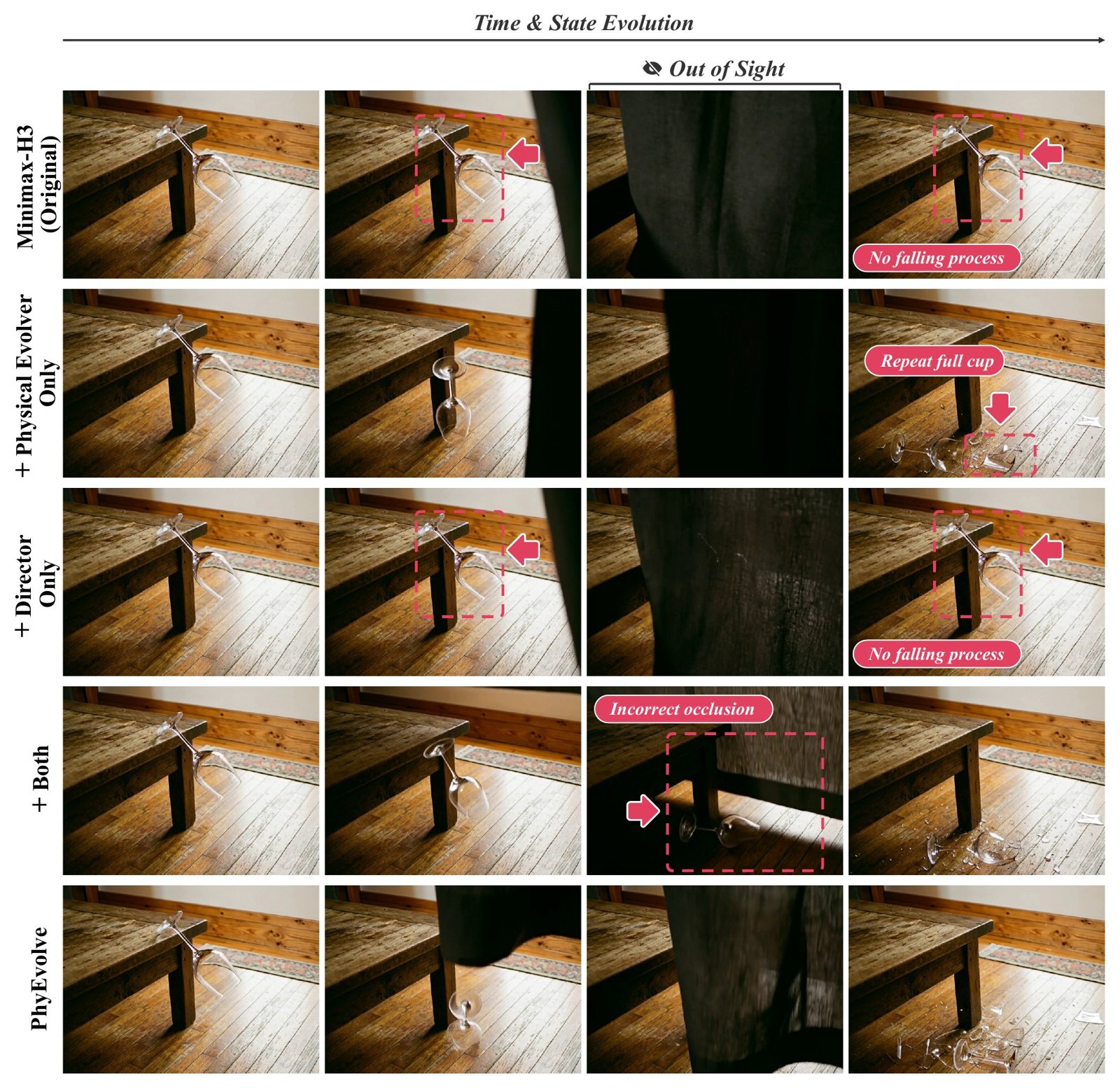
Component ablation on a falling glass hidden by a curtain
Component ablation on a scene where a falling glass is occluded by a curtain.
Table 7: Agent-backbone comparison on PhyGenBench (%).
Agent backboneMechanics ↑Optics ↑Thermal ↑Material ↑Average ↑
InternVL3.5-30B71.787.376.770.877.3
Qwen3.5-9B67.584.081.175.877.3
Qwen3-VL-32B73.384.782.277.579.6
Table 8: User preference for PhyEvolve over each baseline. Each entry is the percentage of votes favoring PhyEvolve.
Benchmarkvs. Minimax-H3vs. NEWTON
VideoPhysicsVideoPhysics
StEvo-Bench81.081.083.883.8
PhyGenBench90.689.481.382.5
PhyWorldBench60.666.969.470.6
VideoPhy-266.363.866.961.9
Overall74.675.375.474.7
Table 9: Efficiency comparison with Minimax-H3 held fixed as the video generator.
MethodLLM calls ↓Tokens (k) ↓End-to-end (s) ↓
NEWTON7.854.31826.5
Co-Director8.020.21009.6
PhyEvolve6.117.0452.5
7

BibTeX

@misc{zhou2026phyevolvemultiagentstateevolutionplanning,
  title         = {PhyEvolve: Multi-Agent State-Evolution Planning for Physics-Aware Video Generation},
  author        = {Yang-Hao Zhou and Lixing Tan and Zhiqi Li and Guang Yang and Xiao Yang},
  year          = {2026},
  eprint        = {2610.30717},
  archivePrefix = {arXiv},
  primaryClass  = {cs.CV},
  url           = {https://arxiv.org/abs/2610.30717}
}